index detection engineering
Java4Shell on Wazuh: Find, Fix and Detect CVE-2026-114938
A Base64 decoder bug in OpenJDK turns a malformed auth header into an out-of-bounds heap write, and in the right conditions into unauthenticated code execution. How to tell if you are exposed, how to fix it, and a four-layer Wazuh rule pack validated through a live 4.9.2 agent: 6 alerts in one run, a crash reproduced 5 times out of 5, and the obvious crash rule firing 0 times.
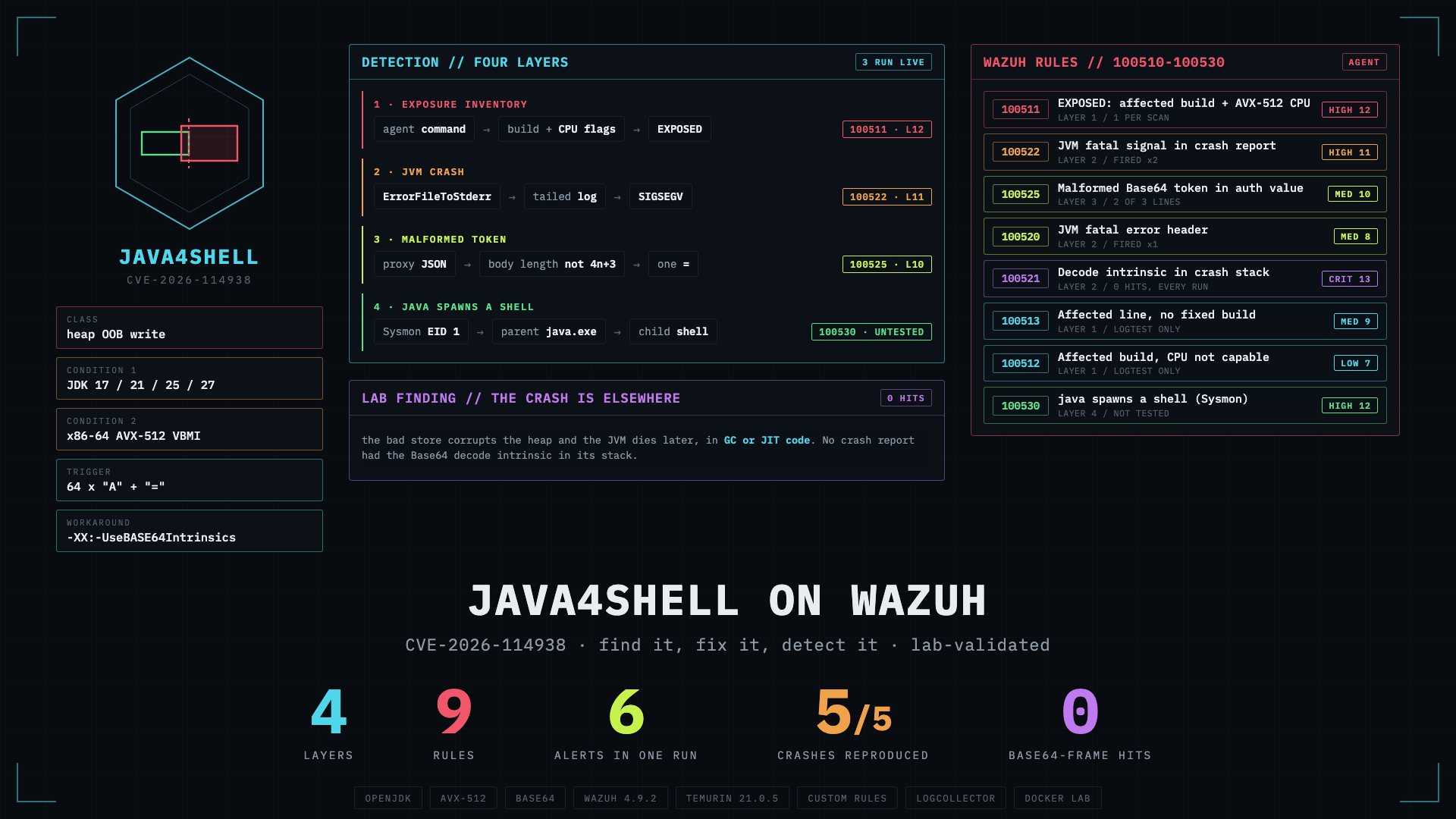
CVE-2026-114938, named Java4Shell, is a critical OpenJDK flaw (CVSS 4.0 score 9.2). A malformed Base64 value, often sent before login, makes the JVM write past the end of a heap buffer. This post covers what the bug is, how to tell if you are exposed, how to fix it, and how to catch it with Wazuh.
The detection part is a four-layer rule pack with a Docker lab. I ran three of
the four layers end to end through an enrolled Wazuh 4.9.2 agent on 20 November
2026, and the lab changed the rules more than once. The pack and the lab are on
GitHub:
nadimjsaliby/wazuh-java4shell-detection.
Vendor facts in this post (fixed builds, exploitation status) are as of 18 November 2026 and move quickly. Confirm them against your vendor's advisory.
What Java4Shell actually is
Researchers at Calif named it Java4Shell and reported it as
CVE-2026-114938. The flaw lives in the hand-written AVX-512 assembly stub
that HotSpot's JIT substitutes for java.util.Base64 decoding once that code
path has run enough times to be compiled. The optimized decoder processes input
in 64-byte blocks and writes results with a masked store.
The bug is in how that stub handles a short, malformed tail. For input that
ends in stray padding such as a single =, the decoder computes an output
length, subtracts one per padding character, and underflows to -1. It
builds the write mask with a BZHI instruction, which reads only the low 8
bits of that length. Minus one is all ones, so the mask ends up all ones too,
and the stub writes a full 64 bytes where it should have written none. The
write lands past the end of the heap output buffer. Java then rejects the input
with an IllegalArgumentException, but only after the bad write has already
happened.
| Property | Value |
|---|---|
| Class | Heap out-of-bounds write |
| Result | Heap disclosure, then remote code execution |
| Authentication needed | Often none |
| Attack complexity | High |
| Disclosed | 17 November 2026 |
| In CISA KEV | No (as of 18 November) |
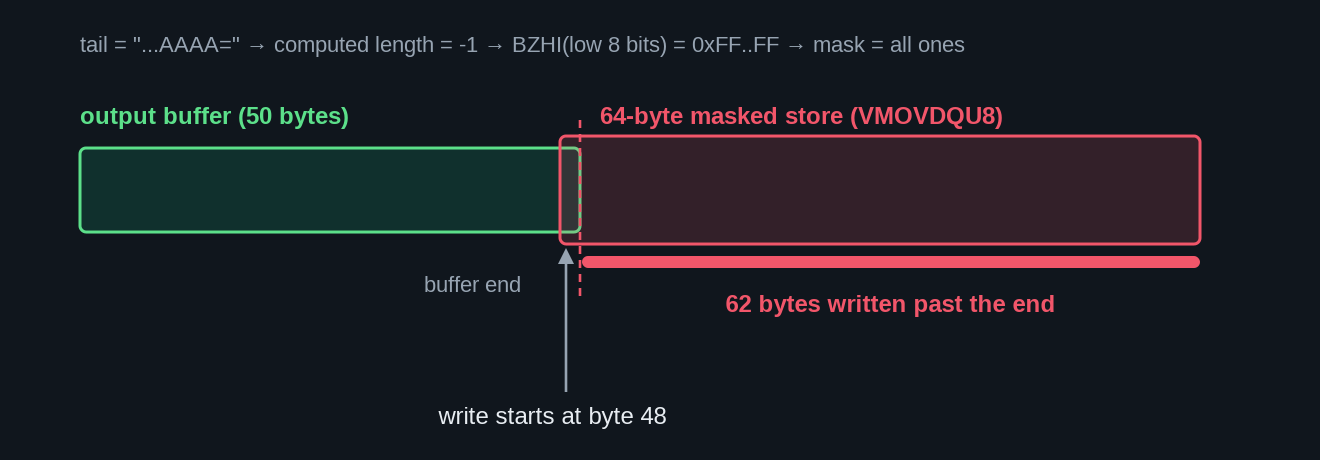
In Calif's example the store begins at byte 48 of a 50-byte buffer and overflows it by 62 bytes. The optimized path only activates after the decoder has run many times, so warm, busy services are the ones at risk.
Why it reaches you before login
Any attacker-controlled Base64 that reaches the decoder is a candidate: HTTP Basic credentials, JWTs, uploaded files, and raw network messages. A lot of that parsing happens before authentication. Calif reported pre-auth remote code execution in default configurations of Keycloak, Jira, Confluence, Artifactory, Jenkins, and PingFederate, and post-auth execution in Kafka, Solr, Elasticsearch, Gerrit, and Spinnaker. There is also a client-side variant, where a Java client that connects to a malicious TLS server can be compromised.
The trigger itself is trivial to send. Calif's proof of concept is 64 A
characters followed by a single =, 65 characters in total. On Java 17 it
takes 128 A characters. That shape, a Base64 token whose length is not a
multiple of four, is the thing worth watching for in logs.
Am I affected?
Two conditions have to hold at the same time: a vulnerable Java build, and a CPU that runs the vulnerable code path. Either one alone is not exploitable, which is why the same container image can be dangerous on one node and safe on the next.
Condition 1: the Java build
| Java line | Affected | Fixed build | Notes |
|---|---|---|---|
| 17 | 17.0.6 to 17.0.21.0.3 | 17.0.21.1 | 17.0.0 to 17.0.5 not affected |
| 21 | 21.0.13.0.3 and earlier | 21.0.13.1 | |
| 25 | 25.0.5.0.3 and earlier | 25.0.5.1 | |
| 27 | 27.0.1.0.3 and earlier | 27.0.1.1 | |
| 8 (Perf Pack) | 8u511b33-perf | 8u513-perf | Enterprise Performance Pack only |
| 18 to 20, 22 to 24, 26 | Affected | No fix | Move to a supported line |
| Standard 8 and 11, OpenJ9, ARM64 | Safe | n/a | Code path not present |
Fixed builds were released on 17 November 2026. Amazon Corretto 17 ships the fix as 17.0.21.1.2. Eclipse Temurin had no fixed build as of 18 November, and Red Hat was expediting RHEL packages. GraalVM 17.0.21.0.3, 21.0.13.0.3 and Enterprise 21.3.20.0.3 are affected.
Build numbers differ by vendor. Do not copy Oracle's build numbers onto Azul Zulu, Microsoft, BellSoft, SAP, or your Linux distribution. Confirm against each vendor's own advisory. The inventory script below reports the raw version so a human can verify the edge cases.
Condition 2: the CPU
Only x86-64 processors that expose avx512f, avx512bw, avx512vbmi, and
bmi2 run the vulnerable stub. That means Intel Ice Lake, Sapphire Rapids,
Emerald Rapids, Granite Rapids, and AMD Zen 4 or newer. ARM servers, including
AWS Graviton and Apple silicon, are not affected.
grep -oE 'avx512vbmi|avx512f|avx512bw|bmi2' /proc/cpuinfo | sort -u
# All four flags present  ->  this host runs the vulnerable code path.
# Missing avx512vbmi      ->  not exploitable, patch on the normal cycle.
Fix it
- Install the vendor's fixed build. Match it to your distribution, not to Oracle's numbering.
- Restart every JVM. A running process keeps the runtime it started with. Patching the package on disk does nothing until the service restarts.
- Rebuild and redeploy container images. Pulling a fresh base image does not touch containers that are already running, and many apps bundle their own JDK that your OS patch cycle never sees.
If you cannot patch yet (x86-64 only). Disable only the vulnerable code with
-XX:-UseBASE64Intrinsics. This is Red Hat's preferred workaround. The alternative,-XX:UseAVX=2, turns off AVX-512 for the whole JVM and can slow other workloads. Never set-XX:UseAVX=2on a non-x86 JVM, which will refuse to start. Set the flag throughJAVA_TOOL_OPTIONSand restart the service.
# 1. After patching, every running JVM must be restarted.
#    Check the runtime actually loaded in the process, not the package on disk:
jcmd -l                               # list running JVMs
jcmd <pid> VM.version                 # the version live in that process
jcmd <pid> VM.flags | tr ' ' '\n' | grep -iE 'UseAVX|UseBASE64Intrinsics'

# 2. Emergency workaround where no fixed build exists yet (x86-64 only):
export JAVA_TOOL_OPTIONS="-XX:-UseBASE64Intrinsics"
#    then restart the service. Confirm it took effect:
jcmd <pid> VM.flags | grep UseBASE64Intrinsics      # expect: -UseBASE64Intrinsics

# Do NOT set -XX:UseAVX=2 on a non-x86 JVM; it will fail to start.
Detect it with Wazuh
Four layers, from cheapest to highest fidelity. The first finds exposure before anyone attacks. The rest catch the attack itself. Rules use the 100510 to 100530 custom ID block; adjust the IDs and levels to your environment. Layers 1 to 3 were run through a live Wazuh 4.9.2 stack with an enrolled agent, and the results are in What the lab showed. Layer 4 has not been through the lab yet and is marked as such.
Layer 1: exposure inventory
This is the detection that actually reduces risk, because it runs before any
attacker shows up. The agent-side script enumerates every Java runtime on disk,
decides whether each build is affected, checks the CPU flags, and prints a
verdict line. A host that is both on an affected build and on an AVX-512 VBMI
CPU is marked EXPOSED.
Save it on the agent as /var/ossec/active-response/bin/java4shell-check.sh:
#!/bin/sh
# java4shell-check.sh - CVE-2026-114938 exposure check for Wazuh logcollector.
# Prints one JAVA4SHELL_SCAN line per Java runtime found. The decoder keys on it.

# --- Condition 2: does this CPU run the vulnerable AVX-512 stub? ---
cpu="no"
if grep -qw avx512vbmi /proc/cpuinfo 2>/dev/null \
   && grep -qw avx512f  /proc/cpuinfo 2>/dev/null \
   && grep -qw avx512bw /proc/cpuinfo 2>/dev/null \
   && grep -qw bmi2     /proc/cpuinfo 2>/dev/null; then
  cpu="yes"
fi

ver_lt() {   # true when $1 is strictly lower than $2
  [ "$1" = "$2" ] && return 1
  [ "$(printf '%s\n%s\n' "$1" "$2" | sort -V | head -n1)" = "$1" ]
}

verdict_for() {   # $1 = raw version string, e.g. 17.0.21.0.3 or 1.8.0_511
  v="$1"
  case "$v" in 1.8.*|8.*|11.*) echo NOT_AFFECTED; return ;; esac
  line="${v%%.*}"
  case "$line" in
    17) ver_lt "$v" 17.0.6   && { echo NOT_AFFECTED; return; }
        ver_lt "$v" 17.0.21.1 && echo AFFECTED || echo FIXED ;;
    21) ver_lt "$v" 21.0.13.1 && echo AFFECTED || echo FIXED ;;
    25) ver_lt "$v" 25.0.5.1  && echo AFFECTED || echo FIXED ;;
    27) ver_lt "$v" 27.0.1.1  && echo AFFECTED || echo FIXED ;;
    18|19|20|22|23|24|26) echo AFFECTED_NOFIX ;;
    *)  echo UNKNOWN ;;
  esac
}

# --- Condition 1: find every java runtime on disk, not just the one on PATH ---
{ command -v java 2>/dev/null
  ls /usr/lib/jvm/*/bin/java /opt/*/bin/java /opt/*/*/bin/java 2>/dev/null
} | sort -u | while read -r jbin; do
  [ -x "$jbin" ] || continue
  v=$("$jbin" -version 2>&1 | awk -F'"' '/version/{print $2; exit}')
  [ -n "$v" ] || continue
  verdict=$(verdict_for "$v")
  # EXPOSED = affected build AND a CPU that runs the bad path. That is "patch now".
  [ "$verdict" = AFFECTED ] && [ "$cpu" = yes ] && verdict=EXPOSED
  line="${v%%.*}"; case "$v" in 1.8.*) line=8 ;; esac
  echo "JAVA4SHELL_SCAN verdict=$verdict version=$v line=$line cpu_avx512vbmi=$cpu bin=$jbin"
done
Run it from the agent
In the agent's /var/ossec/etc/ossec.conf:
<!-- Make it executable first: chmod 750 /var/ossec/active-response/bin/java4shell-check.sh -->
<localfile>
  <log_format>command</log_format>
  <command>sh /var/ossec/active-response/bin/java4shell-check.sh</command>
  <alias>java4shell-check</alias>
  <frequency>86400</frequency>
</localfile>
Agent gotcha. A command defined in the agent's own
ossec.confruns without extra setup. If you push it from the manager with centralizedagent.conf, each agent also needslogcollector.remote_commands=1in itslocal_internal_options.conf, or the command is silently ignored.
Decoder and rules on the manager
/var/ossec/etc/decoders/java4shell_decoders.xml:
<!-- Wrapped: scanner output arriving as logcollector command output. -->
<decoder name="java4shell-scan">
  <parent>ossec</parent>
  <prematch offset="after_parent">JAVA4SHELL_SCAN </prematch>
  <regex type="pcre2">verdict=(\w+) version=(\S+) line=(\S+) cpu_avx512vbmi=(\w+) bin=(\S+)</regex>
  <order>j4s_verdict, j4s_version, j4s_line, j4s_cpu, j4s_bin</order>
</decoder>

<!-- Bare: standalone run, a tailed log file, or wazuh-logtest input. -->
<decoder name="java4shell-scan">
  <prematch>JAVA4SHELL_SCAN </prematch>
  <regex type="pcre2">verdict=(\w+) version=(\S+) line=(\S+) cpu_avx512vbmi=(\w+) bin=(\S+)</regex>
  <order>j4s_verdict, j4s_version, j4s_line, j4s_cpu, j4s_bin</order>
</decoder>
/var/ossec/etc/rules/java4shell_rules.xml:
<group name="java4shell,cve_2026_114938,">

  <!-- Base: any scan line. Level 0 so it never alerts on its own.
       Keyed on the decoded field, so it matches the wrapped and the bare form. -->
  <rule id="100510" level="0">
    <field name="j4s_verdict">\w+</field>
    <description>Java4Shell exposure scan result.</description>
  </rule>

  <!-- Affected build AND AVX-512 VBMI CPU: patch and restart now. -->
  <rule id="100511" level="12">
    <if_sid>100510</if_sid>
    <field name="j4s_verdict">^EXPOSED$</field>
    <description>Java4Shell (CVE-2026-114938): Java $(j4s_line) at $(j4s_version) on an AVX-512 VBMI CPU ($(j4s_bin)). Patch and restart now.</description>
    <group>vulnerability,</group>
  </rule>

  <!-- Affected build, CPU not capable: still patch, lower urgency. -->
  <rule id="100512" level="7">
    <if_sid>100510</if_sid>
    <field name="j4s_verdict">^AFFECTED$</field>
    <description>Java4Shell: affected Java $(j4s_line) at $(j4s_version) found; CPU lacks AVX-512 VBMI. Patch on the next window.</description>
    <group>vulnerability,</group>
  </rule>

  <!-- Affected line with no fixed build. -->
  <rule id="100513" level="9">
    <if_sid>100510</if_sid>
    <field name="j4s_verdict">^AFFECTED_NOFIX$</field>
    <description>Java4Shell: Java $(j4s_line) at $(j4s_version) is affected and has no fixed build. Move to a supported line.</description>
    <group>vulnerability,</group>
  </rule>

</group>
One gap to know about: the script treats every Java 8 build as not affected, so it will not flag the Java 8 Enterprise Performance Pack build listed in the table above. Check those hosts by hand.
The decoder comes in two blocks with the same name, on purpose. When the
scanner runs as a logcollector command, the manager receives the line wrapped
as ossec: output: 'java4shell-check': JAVA4SHELL_SCAN ..., the built-in
ossec decoder claims it, and a plain top-level decoder never gets a turn. The
first block is a child of ossec for that wrapped form. The second handles a
bare line from a tailed file or wazuh-logtest. For the same reason the base
rule matches on the decoded j4s_verdict field, not on decoded_as, which
would only ever be true for the bare form.
Layer 2: the JVM crash
The overflow frequently crashes the JVM before it ever achieves clean code execution, so the crash report is worth collecting. My first draft of this layer only alerted when the crash stack sat inside the Base64 decode routine. The lab showed why that is not enough.
What the real crash looks like. An out-of-bounds write does not have to fault where it happens. In the lab the bad store silently corrupted neighbouring heap memory and the JVM died somewhere else, a little later. One crash had its problematic frame in the garbage collector (
DefNewGeneration::copy_to_survivor_space). Another had it in JIT-compiled application code. None of the crash reports I collected had the decode intrinsic in the stack, so a rule that waits for it fired zero times.
So the layer is three rules. 100520 marks the fatal-error header. 100521 keeps the high-confidence case, a crash stack that references the decode intrinsic. 100522 catches what the lab actually produced: the fatal-signal line that only a JVM crash report prints.
Do not tail
hs_err_pid*.log. The obvious setup is-XX:ErrorFile=/var/log/jvm/hs_err_pid%p.logplus a<localfile>with a wildcard. It ships nothing. On Wazuh 4.9.2 the logcollector starts at the end of a file it discovers through a wildcard, with or withoutonly-future-events, and a JVM writes its crash file once and never appends to it. In the lab the crash file was found and tracked, and zero lines left the agent. Send the report to a log that already exists and grows.
First, send the crash report to stderr, so it lands in the log the service already writes (a file, journald, or the container log):
export JAVA_TOOL_OPTIONS="-XX:+ErrorFileToStderr"
Then tail that log with the agent. The file must exist before the agent starts:
<localfile>
  <log_format>syslog</log_format>
  <location>/var/log/myservice/stderr.log</location>
</localfile>
The rules, in the same java4shell_rules.xml:
<group name="java4shell,cve_2026_114938,jvm_crash,">

  <!-- The fatal-error header that opens every JVM crash report. -->
  <rule id="100520" level="8">
    <match>A fatal error has been detected by the Java Runtime Environment</match>
    <description>JVM fatal error reported (crash).</description>
  </rule>

  <!-- High confidence, rare: the crash stack references the decode intrinsic.
       Only the synchronous case, where the bad store faults inside the stub. -->
  <rule id="100521" level="13">
    <regex type="pcre2">base64_decodeBlock|StubRoutines::.{0,40}base64</regex>
    <description>Java4Shell (CVE-2026-114938): JVM crash stack references the Base64 decode intrinsic. Treat as an exploitation attempt.</description>
    <group>attack,</group>
  </rule>

  <!-- The realistic case: heap corruption that faults somewhere else, later.
       Matches the fatal-signal line unique to JVM crash reports. Fires on ANY
       hard JVM crash, so level 11 (investigate), not an attack verdict. -->
  <rule id="100522" level="11">
    <regex type="pcre2">SIG(SEGV|BUS|ILL|FPE)\s+\(0x[0-9a-f]+\)\s+at pc=0x</regex>
    <description>Java4Shell (CVE-2026-114938): JVM fatal signal in a crash dump (possible Base64 heap corruption). Correlate with exposure (Layer 1) and malformed tokens (Layer 3).</description>
    <group>attack,</group>
  </rule>

</group>
Rule 100522 fires on any hard JVM crash, not only this CVE, which is why it
sits at level 11 and reads as "investigate", not as an attack verdict. Escalate
when it lands on a host that Layer 1 marked EXPOSED, or near a Layer 3 hit.
Expect more than one alert per crash: the lab crashes raised it two or three
times each, once for the header and again for error occurred during error
reporting lines that repeat the signal.
Do not widen 100521 to match java.util.Base64 anywhere in the report. Its
event log lists class loads such as Loading class java/util/Base64$Decoder,
so that pattern would match the crash report of almost any application that
uses Base64.
Layer 3: the malformed token on the wire
The trigger is a Base64 value with an impossible length, ending in a single
=. If a reverse proxy or WAF logs the Authorization value or token, you can
match it. A single trailing = on its own is useless as a signal, because
about a third of all valid Basic credentials end that way. What separates them
is the length: a valid value with one = has 4n+3 characters before it, and
the trigger has 4n, 4n+1 or 4n+2. The regex counts the body in groups of four
and allows at most two leftovers. Treat the rule as opportunistic all the same,
since it only sees what your proxy logs.
Adapt the field to your proxy decoder:
<group name="java4shell,cve_2026_114938,">

  <!-- Adapt decoded_as and the field name to how YOUR proxy or WAF logs the value.
       Valid Base64 ending in one "=" has a body of 4n+3 characters. The trigger has a
       body of 4n, 4n+1 or 4n+2, so count groups of four and allow at most two leftovers. -->
  <rule id="100525" level="10">
    <decoded_as>json</decoded_as>
    <field name="authorization" type="pcre2">(?i)^(basic|bearer)\s+(?:[A-Za-z0-9+/_-]{4}){10,}[A-Za-z0-9+/_-]{0,2}=\s*$</field>
    <description>Java4Shell: malformed Base64 token (invalid length before a single trailing padding) in an Authorization value. Possible trigger.</description>
    <group>attack,</group>
  </rule>

</group>
Layer 4: Java spawns a shell
The most reliable signal for any Java remote code execution is behavioral: the JVM starting a shell or a download tool. This needs process-creation telemetry feeding the agent. The rule below is for Sysmon on Windows.
<group name="java4shell,cve_2026_114938,post_exploitation,">

  <!-- Windows: Sysmon Event ID 1, java spawns a shell or LOLBin. -->
  <rule id="100530" level="12">
    <if_group>sysmon_event1</if_group>
    <field name="win.eventdata.parentImage" type="pcre2">(?i)\\javaw?\.exe$</field>
    <field name="win.eventdata.image" type="pcre2">(?i)\\(cmd|powershell|pwsh|wscript|cscript|mshta|certutil|bitsadmin|curl)\.exe$</field>
    <description>Java4Shell: java spawned $(win.eventdata.image). Possible post-exploitation command execution.</description>
    <mitre><id>T1190</id><id>T1059</id></mitre>
    <group>attack,</group>
  </rule>

</group>
Not lab-validated yet. This layer did not go through the lab, so treat it as a starting point. There is no Linux rule here on purpose: the
win.eventdata.*fields exist only for Windows event channel events, so a Linux rule written against them never matches. On Linux, write the same parent and child match against the fields your own process telemetry decodes to (auditd or Sysmon for Linux) and prove it withwazuh-logteston a real event.Baseline first. Jenkins, Gradle, and CI agents start shells constantly, so this rule will light up on build nodes. Baseline each service and exclude its legitimate child processes before you promote it.
Validate before you deploy
Reload the manager after editing decoders or rules, then replay a sample line through the analysis engine. If the decoder and rule are wired correctly, you will see the fields populated and rule 100511 at level 12.
# Reload after editing decoders/rules:
systemctl restart wazuh-manager

# Replay a sample scan line; expect j4s_* fields set and rule 100511 at level 12:
echo 'JAVA4SHELL_SCAN verdict=EXPOSED version=17.0.21.0.3 line=17 cpu_avx512vbmi=yes bin=/usr/lib/jvm/jdk-17/bin/java' \
  | /var/ossec/bin/wazuh-logtest
What the lab showed
I ran the pack on an x86-64 host with AVX-512 VBMI (AMD EPYC Genoa). The endpoint is a container with Eclipse Temurin 21.0.5+11 and a Wazuh 4.9.2 agent on the same box, enrolled with a Wazuh 4.9.2 manager, indexer and dashboard. Everything stayed on a private bridge network. Every alert below came through the agent.
| Measure | Result |
|---|---|
| Alerts in the run shown | 6 |
| Rules that fired | 4 of 5 tested live |
| Base64 frame rule (100521) | 0 hits, every run |
| Crash reproduced | 5 of 5 runs |
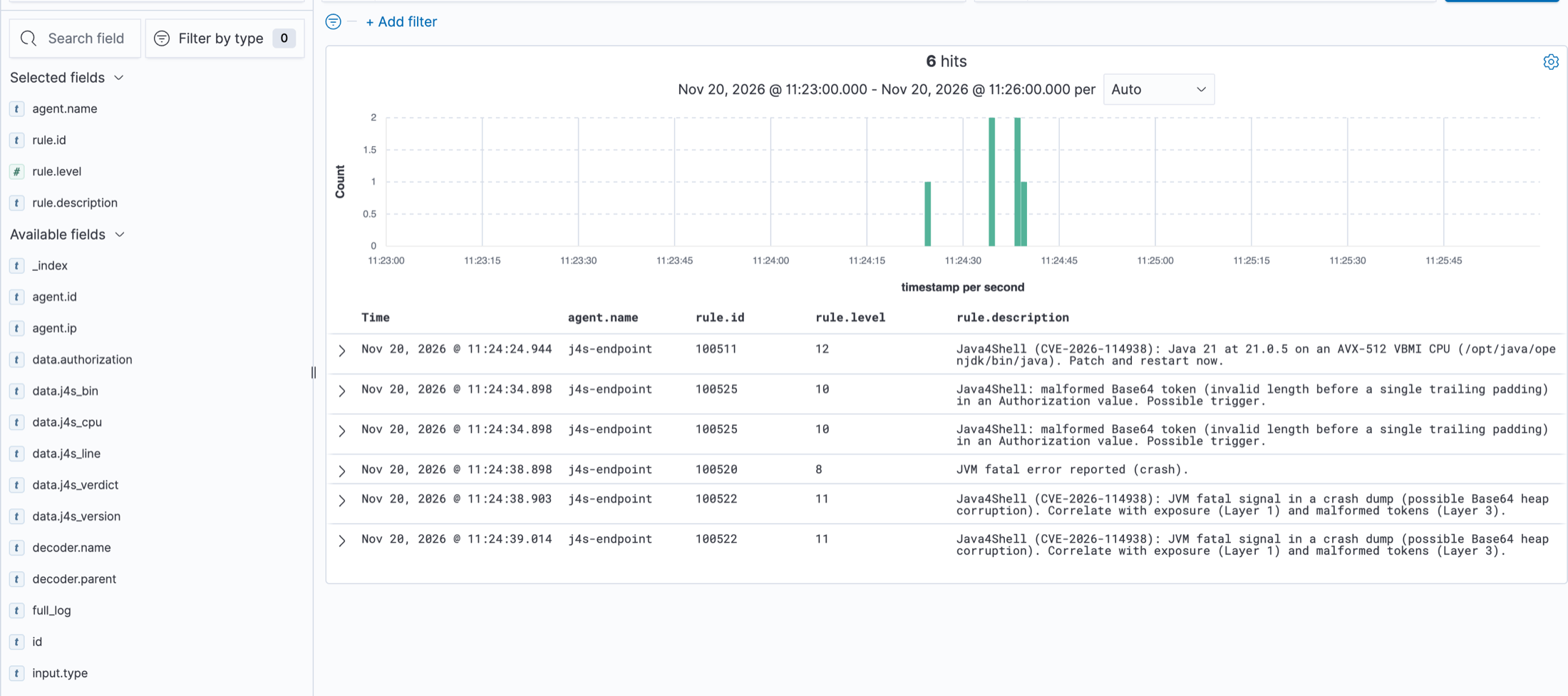
One run, start to finish, filtered on rule.groups:java4shell: the exposure
scan, two malformed tokens, then the crash. All six alerts come from the agent
j4s-endpoint.
Layer 1 result: the scan, from a real agent
The agent runs the script as a logcollector command. The output arrives
wrapped, the child decoder picks out the fields, and rule 100511 fires at level
12 because the build is affected and the CPU runs the vulnerable path.
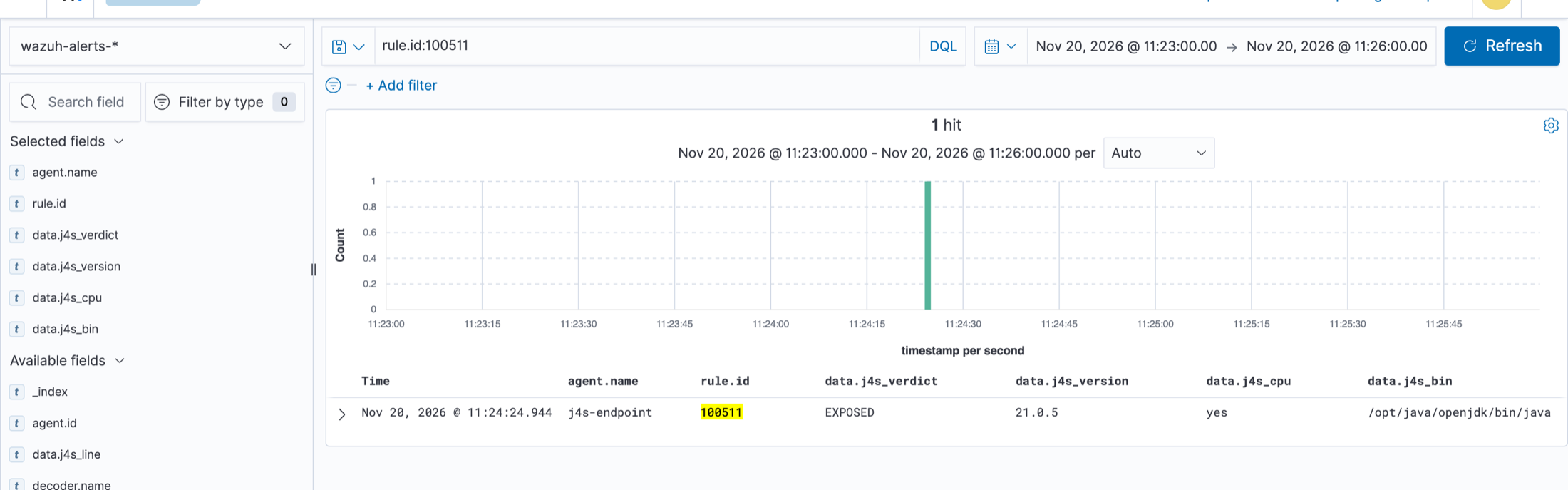
The decoded j4s_* fields, one verdict per runtime, so you can sort a fleet by
what to patch first.
The other verdicts cannot come from this one host, so I checked them with
sample lines in wazuh-logtest: AFFECTED raised 100512, AFFECTED_NOFIX
raised 100513, and FIXED raised nothing.
Layer 2 result: getting it to crash at all
A plain loop that decodes the 65-character trigger did not crash the JVM, even
after roughly 118 million iterations. The write lands in heap memory that
nothing reads back. It took heap pressure to turn corruption into a fault: a 32
MB heap, the serial collector, several threads, and small live allocations
around every decode. With that, the JVM died with SIGSEGV on five runs out of
five. In the run shown it took 3.8 seconds.
The crash report on stderr, from the lab endpoint:
# A fatal error has been detected by the Java Runtime Environment:
#
#  SIGSEGV (0xb) at pc=0x0000726dac2e51c1, pid=521, tid=535
#
# JRE version: OpenJDK Runtime Environment Temurin-21.0.5+11 (21.0.5+11) (build 21.0.5+11-LTS)
# Problematic frame:
# J 185% c2 Base64Crash.lambda$main$0(Ljava/util/Base64$Decoder;)V (151 bytes) @ 0x0000726dac2e51c1

Command Line: -Xmx32m -XX:+UseSerialGC -XX:+ErrorFileToStderr Base64Crash

Native frames:
J 185% c2 Base64Crash.lambda$main$0(Ljava/util/Base64$Decoder;)V (151 bytes)
j  Base64Crash$$Lambda+0x0000726d640009f8.run()V+4
j  java.lang.Thread.runWith(Ljava/lang/Object;Ljava/lang/Runnable;)V+5 [email protected]
j  java.lang.Thread.run()V+19 [email protected]
In this run the problematic frame is the JIT-compiled test loop. In an earlier
run of the same program it was DefNewGeneration::copy_to_survivor_space, deep
in the garbage collector. Where the JVM falls over depends on what the stray 62
bytes happened to hit.
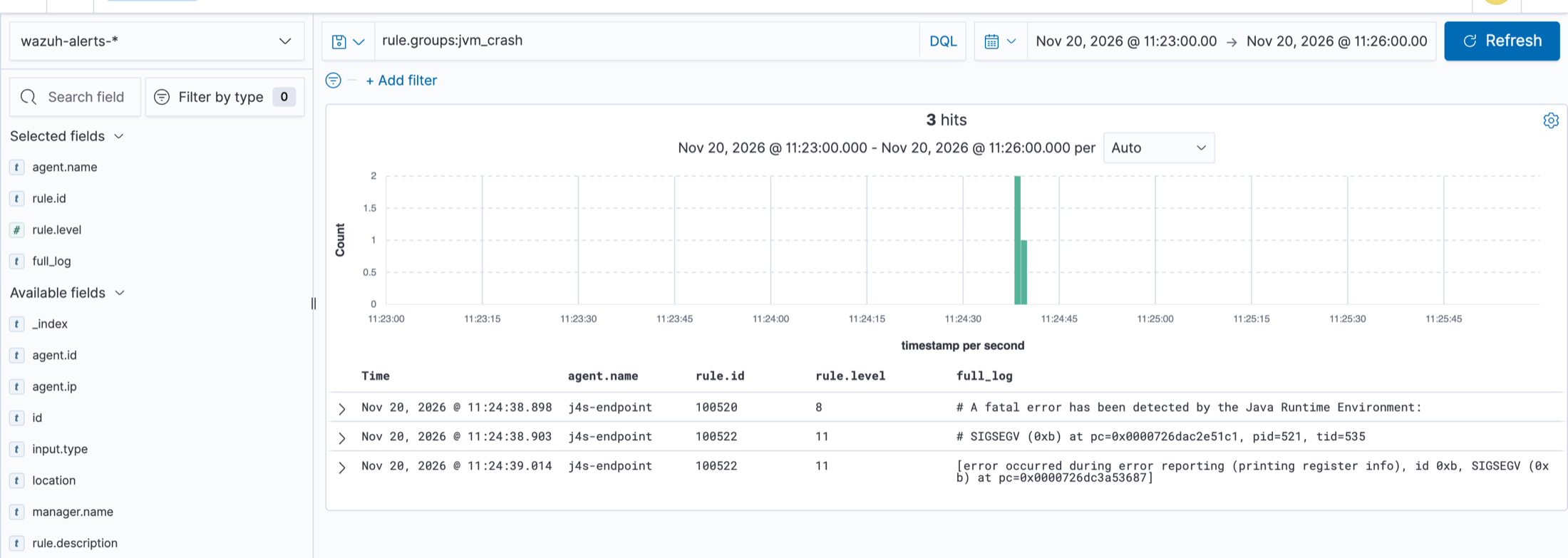
The crash in the Wazuh dashboard: 100520 on the header, 100522 on the two fatal-signal lines. 100521 did not fire, because the report has no decode-intrinsic frame.
Layer 3 result: tokens, including one that must not alert
I appended three lines to a sample proxy log that the agent tails: the
64-character trigger as a Basic value, a longer malformed Bearer value, and an
ordinary valid Basic credential that also ends in a single =. Two alerts, as
intended.
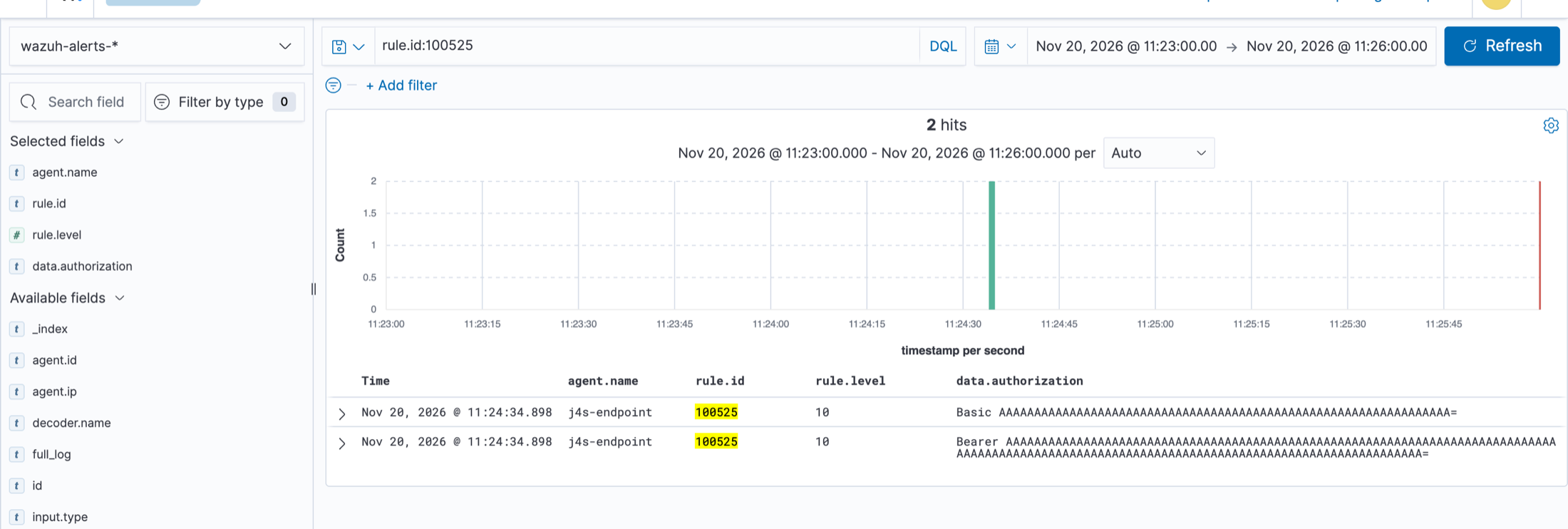
Rule 100525 on the two malformed values. The valid credential in the same file stayed silent.
What fired
| Rule | Level | Layer | Alerts in the run shown | Input |
|---|---|---|---|---|
| 100511 | 12 | 1, exposed | 1 per scan | Real scanner output |
| 100512 | 7 | 1, affected build, safe CPU | logtest only | Sample scan line |
| 100513 | 9 | 1, no fixed build | logtest only | Sample scan line |
| 100520 | 8 | 2, fatal error header | 1 | Real crash report |
| 100521 | 13 | 2, decode intrinsic in the stack | 0 | Real crash report |
| 100522 | 11 | 2, fatal signal | 2 | Real crash report |
| 100525 | 10 | 3, malformed token | 2 of 3 lines | Sample proxy JSON |
| 100530 | 12 | 4, java spawns shell | Not tested | None |
Three things that broke first
- The crash file was never shipped. My first config tailed
hs_err_pid*.logwith a wildcard. The agent found each new file and read none of it. That is the reason Layer 2 now collects from stderr. - The token rule alerted on normal logins. The first version matched any
value ending in a single
=. The valid credential in the sample file is there to keep that from coming back. - The agent died right after enrolling. The manager tells a new agent to
restart, and in a container with no init that restart waits forever on zombie
processes. The lab's compose file sets
init: true.
What the lab does not prove. The proxy lines are samples, not traffic through a real proxy. Rules 100512 and 100513 were checked with sample lines in
wazuh-logtestonly. Layer 4 was not tested. The crash came from a purpose-built stress program, not from a request to a real application such as Keycloak, and nothing here attempts code execution.
Reality check
Oracle scores this 8.1 and flags high attack complexity for a reason. Turning the overflow into reliable code execution depends on the specific CPU, the JDK build, the exact Base64 input, and the JIT having warmed the vulnerable path. As of 18 November 2026 there was no reported exploitation in the wild and the CVE was not in CISA's KEV catalog.
That is not a reason to wait. The precondition, attacker-controlled Base64 reaching the decoder, is met by a long list of widely deployed, internet-facing software, often before authentication, and the trigger is a single short string. Patch internet-facing Keycloak, Jira, Confluence, Artifactory, Jenkins, and PingFederate on AVX-512 hardware first, put admin interfaces behind a VPN or allow list in the meantime, and use the exposure inventory to drive the rest of the rollout. The crash rule is your safety net while you work through the list.
Order of operations. Inventory with Layer 1, deploy Layers 2 and 4 everywhere, patch and restart the EXPOSED internet-facing hosts first, rebuild containers, then confirm the live runtime with
jcmd VM.version, not the package version.
Resources
- Wazuh: the open source security platform, unified XDR and SIEM protection
- Wazuh Ambassadors Program
- Rule pack + lab:
nadimjsaliby/wazuh-java4shell-detection - Calif: Java4Shell, write once, RCE everywhere (original disclosure)
- JFrog: what we know about the critical OpenJDK RCE
- ThreatDefence: Java 17 to 27 fixes and hunting
- Tenable: OpenJDK RCE FAQ
- Qualys: how to find, mitigate, and patch
- Help Net Security: exploitation is tricky and hinges on specific CPUs
- Palo Alto Networks: risks and mitigations
- The Hacker News: enables pre-auth RCE in Jira, Jenkins, Keycloak
Severity is scored CVSS 3.1 8.1 by Oracle and OpenJDK, CVSS 4.0 9.2 by Calif,
and 9.8 by Red Hat. Versions and fixes were accurate when written and change as
vendors ship builds; confirm against your vendor's advisory. Rule IDs and
levels are starting points to tune, not drop-in production rules. Test every
decoder and rule with wazuh-logtest in a lab before deploying.
This post was produced for the Wazuh Ambassadors Program. Wazuh is a free, open source security platform.